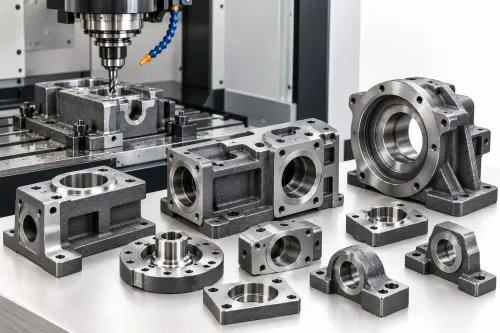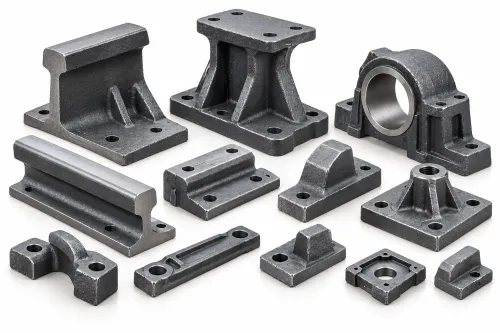
Turning is suitable when a cast iron rail part depends on accurate rotational features such as journals, bores, shoulders, threads, or bearing seats. It is not a complete manufacturing route for every rail component: the casting method, iron grade, loading conditions, secondary operations, and inspection requirements determine whether the finished part is fit for service. By the end, you can separate a practical cast-and-machined design from one that needs a different material or process.
Key takeaways
- Use turning for cast rail parts with a stable axis and rotational critical features.
- Select the iron grade from rail loads, impact, wear, and vibration requirements.
- Specify casting defects, machining tolerances, hardness, and inspection methods on the drawing.
- Audit a supplier’s casting controls, machining capability, and traceability before approval.
When turning is the right process for a cast rail part
Turning is suitable when a cast rail part has a stable axis and its critical features are rotational: outside diameters, bores, journals, concentric seats, shoulders, threads, or bearing surfaces.
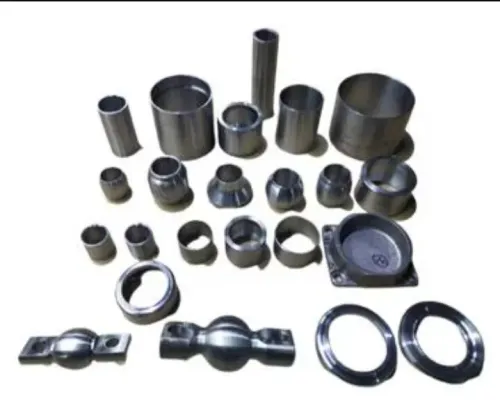
These features let a lathe establish diameter, roundness, and coaxiality efficiently, making turned components for cast iron rail parts practical for bushes, pins, collars, spacers, and threaded bosses.
| Feature or requirement | Turning’s role | Process to add |
|---|---|---|
| Cylindrical outside diameter or bore | Produces the diameter and concentric surface | Pattern and mould work for the basic cast shape |
| Keyway, flat, or non-circular face | Cannot create the required geometry | Milling, broaching, or shaping |
| Bolt-hole pattern | Does not locate multiple off-axis holes | Drilling, boring, or tapping |
| Bearing fit with very tight size or surface finish | Roughing and finish-turning may establish the form | Grinding after heat treatment or stabilisation |
| Large casting with heavy material removal | Removes stock but does not eliminate movement | Controlled ageing or stress relief before final machining |
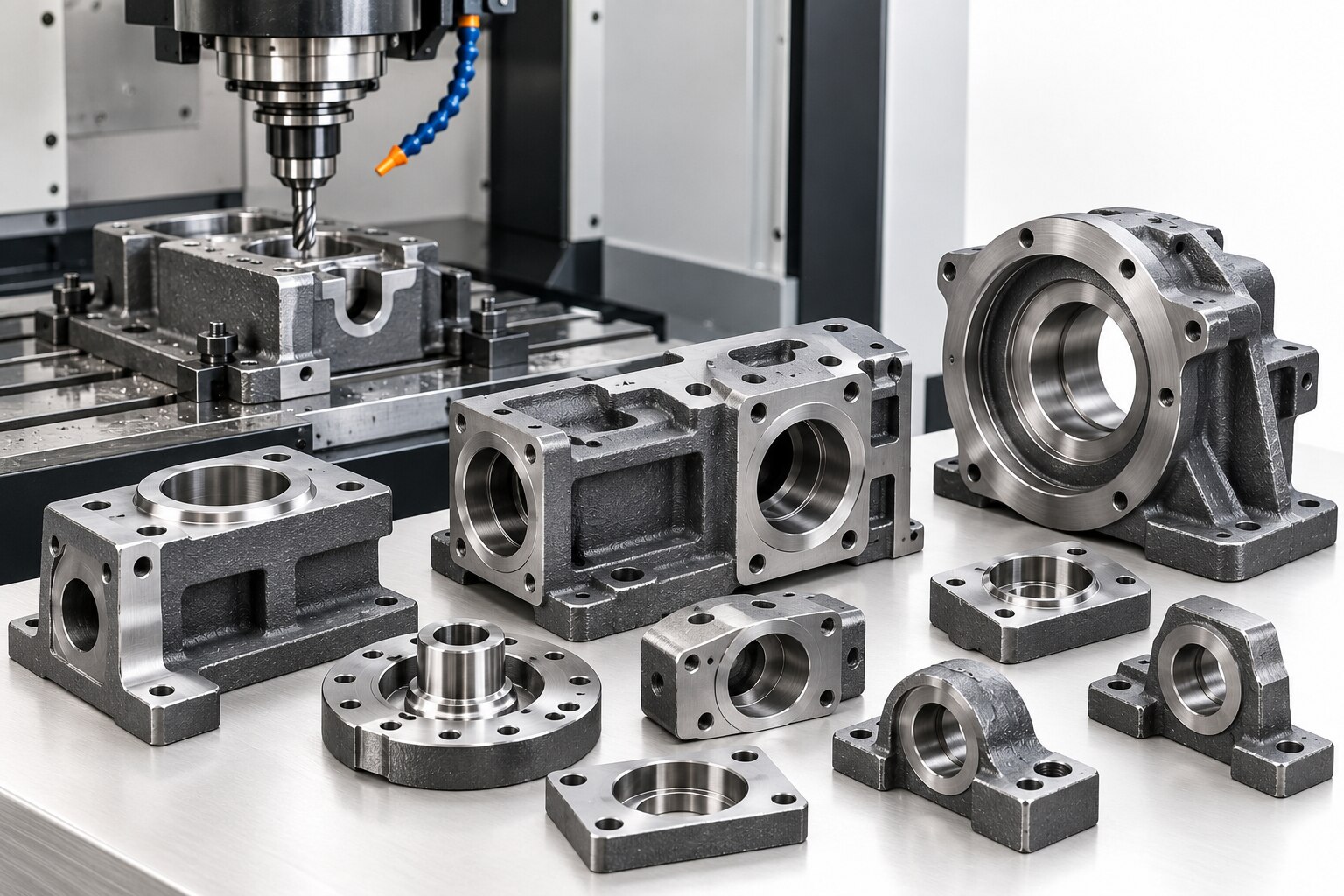
Turning alone is the wrong choice when the part depends on flatness, intersecting holes, prismatic faces, or impact-loaded geometry. A cast iron housing may be turned for its bore and then milled on its mounting face and drilled for fasteners; the casting supplies the shape, while each machining process supplies a different functional surface.
Residual stress can move a part after it passes an immediate size check. For larger turned cast iron components, inspect after stress relief and thermal stabilisation, not only straight off the lathe. Safety-critical rail parts also need the governing railway specification and design approval before you select cast iron.
Choose the iron grade from the rail load, not the label “CI”
A rail component ordered simply as “CI” has no defensible load rating. Specify the grade, such as ASTM A48 gray iron or ASTM A536 ductile iron, then match it to compression, tensile load, impact, and cyclic fatigue. Graphite shape controls the decision because flakes interrupt the matrix more severely than nodules or compacted graphite.
| Iron type | Graphite structure | Service behaviour | Turning decision |
|---|---|---|---|
| Gray iron | Flakes | Excellent damping and compressive performance; limited tensile and impact resistance | Use for lightly shocked housings, covers, or compressive seats after confirming the grade and section strength |
| Ductile iron | Spheroidal nodules | Higher tensile strength, elongation, impact resistance, and fatigue capability | Prefer it for loaded pins, collars, bearing carriers, and sections exposed to shock or reversing loads |
| Compacted-graphite iron | Short, interconnected vermicular particles | A middle ground in strength, thermal performance, damping, and machinability | Consider it when gray iron lacks strength but ductile iron is unnecessary |
For cast iron rail products, inspect the actual load path, not the part name. A gray-iron bearing seat under repeated impact is a different risk from a gray-iron spacer carrying compression. Ductile iron is not automatically correct: its grade, hardness, wall thickness, and heat treatment still need verification.
Large or heavily machined castings can move after rough turning as residual stress relaxes. Include stress relief or controlled ageing where required, and finish-inspect after thermal stabilisation; a part that passes immediately after machining can later lose its concentricity or fit.
Control the casting and machining route together
A turned diameter can meet its drawing size and still fail in service if the casting skin, an inclusion, tool wear, or residual stress was ignored. Turned components for cast iron rail parts need one linked route from mould design to final inspection:
1. Control the metal and mould before machining. Record the iron grade, melt or batch number, hardness, pouring data, and approved pattern revision. Use suitable feeders, filters, and gating to reduce shrinkage and slag inclusions; inspect the casting for cracks, sand adherence, exposed graphite, and internal defects before it reaches the lathe.
2. Leave enough machining allowance to remove the casting skin completely. Do not assume a light finishing pass will clean a rough or decarburised surface. Establish rough-turning datums from stable cast surfaces, then verify that the remaining allowance is adequate for the specified diameter, bore, shoulder, and thread.
3. Control tool wear as a measured process. Set a tool-life limit, inspect inserts for flank wear and chipped edges, and record the tool condition against batch and machine. Enclose the operation and extract graphite-and-metal dust; compressed air can drive abrasive dust into linear guides, chucks, and measurement equipment.
4. Manage stress before finishing. For a large or heavily machined casting, rough-machine it, apply the specified stress-relief treatment or controlled ageing, and allow thermal stabilisation before finish turning. Recheck runout, concentricity, and critical diameters after stabilisation; a part that moved in storage was never truly under control.
Keep casting inspection, machining records, and final dimensional results under the same traceability number. Segregate nonconforming castings and worn-tool output instead of blending them into an acceptable batch.
Put measurable requirements on the drawing and inspection plan
Put acceptance numbers on both the casting drawing and the machined-part drawing before requesting a quotation. The casting document needs the iron grade, casting-tolerance class, machining allowances, and ISO 8062-3 reference. The machined document needs datum A, B, and C, with each datum physically identified on the part.
| Control | Drawing requirement | Inspection evidence |
|---|---|---|
| Casting geometry | Dimensions, allowance, draft, and tolerance class | Pattern and first-off casting report |
| Turned features | Diameters, bore size, shoulder position, thread, cylindricity, runout, concentricity, and Ra finish | Calibrated gauges, CMM results, and surface-finish record |
| Material | Grade, hardness range, chemistry, graphite structure, and batch identification | Heat certificate, hardness test, and metallography |
| Defects | No cracks, cold shuts, exposed shrinkage, unacceptable inclusions, or unapproved weld repairs; state repair limits | Visual inspection, sectioning or approved NDT report |
| Stability | Rough-machining stock, stress-relief or controlled-ageing treatment, and stabilisation time before finishing | Treatment log and final inspection after thermal stabilisation |
Specify which surfaces establish the datums and where measurement begins; otherwise two inspectors can report different answers from the same part. Define whether runout is measured to datum A, and name the gauge or CMM method.
Use magnetic-particle inspection for specified surface and near-surface areas when the grade permits it. Do not accept a generic steel UT procedure for gray iron: flake graphite scatters sound. For rail parts for manufacturers, require nonconformance segregation and approval of any deviation before shipment.
How to assess a supplier before approving the part
Approve the supplier only after reviewing objective records, not a capability brochure. For rail parts for manufacturers, ask to see one complete lot file linking the approved pattern to the finished component.
1. Confirm pattern and mould control. Review the revision-controlled pattern drawing, pattern approval record, moulding method, machining allowances, and casting-tolerance class, such as the framework in ISO 8062-3.
2. Check material identity. The supplier must link each casting to a heat or batch number and provide the specified iron grade, graphite structure, hardness results, and any chemical or metallurgical test records.
3. Follow the process route. Inspect the control plan for pouring, fettling, visual defect acceptance, rough machining, datum establishment, tool-life limits, and dust extraction. For large or heavily machined parts, look for documented ageing or stress relief between roughing and finishing.
4. Verify final inspection capability. Request sample reports showing bore and diameter measurements, runout, concentricity, thread checks, surface finish, and inspection after thermal stabilisation. Confirm that gauges and measuring equipment have current calibration records.
5. Test nonconformance control. Ask where rejected castings and machined parts are physically segregated, how deviations receive approval, and whether corrective actions identify the affected batch.
A supplier found through “ci casting parts in pune” is a sourcing lead, not proof of conformity. Virdaks Engineering India Private Limited belongs on your comparison list only after it supplies this chain of evidence for the specific cast iron rail products you intend to approve.
Related products
 | Rail Parts Virdaks Engineering offers precision-manufactured rail parts for railway applications — engineered to meet rigorous standards of durability,... View product → |
 | Rail Parts Virdaks Engineering Overview Virdaks Engineering offers high-quality CI (Cast Iron) Casting Parts manufactured to meet the demanding requirements of... View product → |
Frequently asked questions
When is turning the right process for a cast iron rail part?
Turning suits a cast rail part with a stable axis and rotational features such as outside diameters, bores, journals, concentric seats, shoulders, threads, or bearing surfaces.
How should you choose the cast iron grade for a rail part?
Choose the grade from the rail load, impact, wear, vibration, and dimensional requirements rather than using the broad label “CI” alone.
What requirements belong on the drawing and inspection plan?
State the iron grade, casting condition, machining tolerances, surface finish, hardness, allowable defects, datum scheme, inspection method, and required records.
How do you assess a supplier of turned cast iron rail components?
Review the supplier’s foundry controls, machining capacity, inspection equipment, material traceability, defect handling, sample records, and ability to control casting and machining as one route.
Related product
 | CI Parts Virdaks Engineering India Private Limited supplies high-quality Cast Iron (CI) parts engineered to meet strict UK industrial standards. View product → |
Keywords