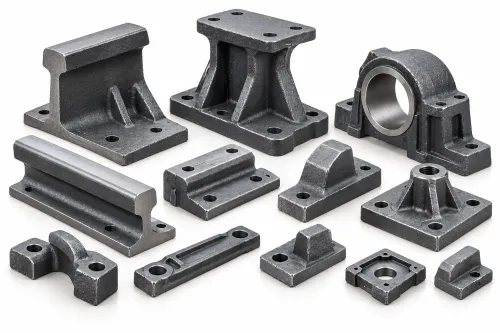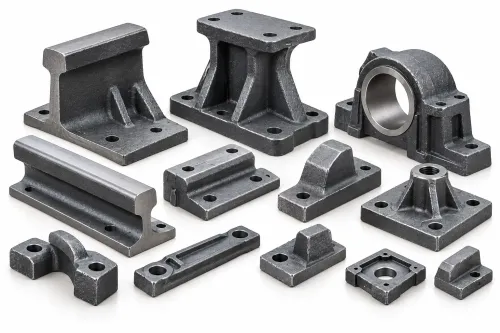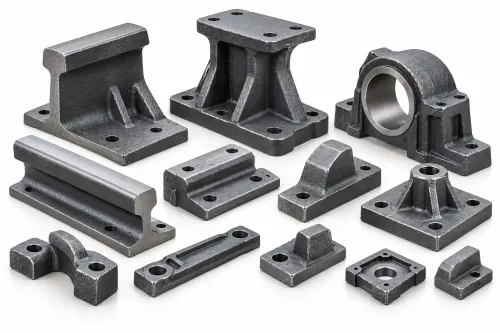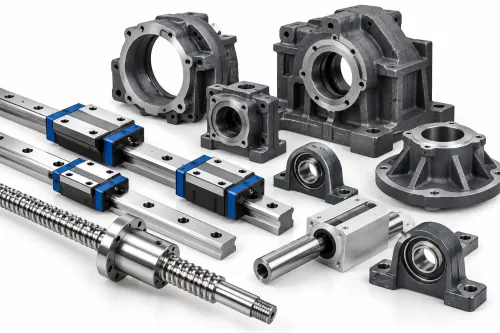
A VMC description tells you how a part is machined, not what cast iron grade, tolerance, inspection route or price you are buying. By the end, you will be able to prepare a usable RFQ, judge whether a casting suits VMC work and compare Pune suppliers on process evidence rather than brochure claims.
Key takeaways
- Match the cast iron grade to strength, wear and machining requirements.
- Give the machinist datums, tolerances, stock allowance and hole details.
- Control vibration with rigid fixturing, suitable cutting data and staged inspection.
- Compare quotes by process scope, inspection records, tooling and delivery terms.
What a VMC Does to a Cast Iron Casting
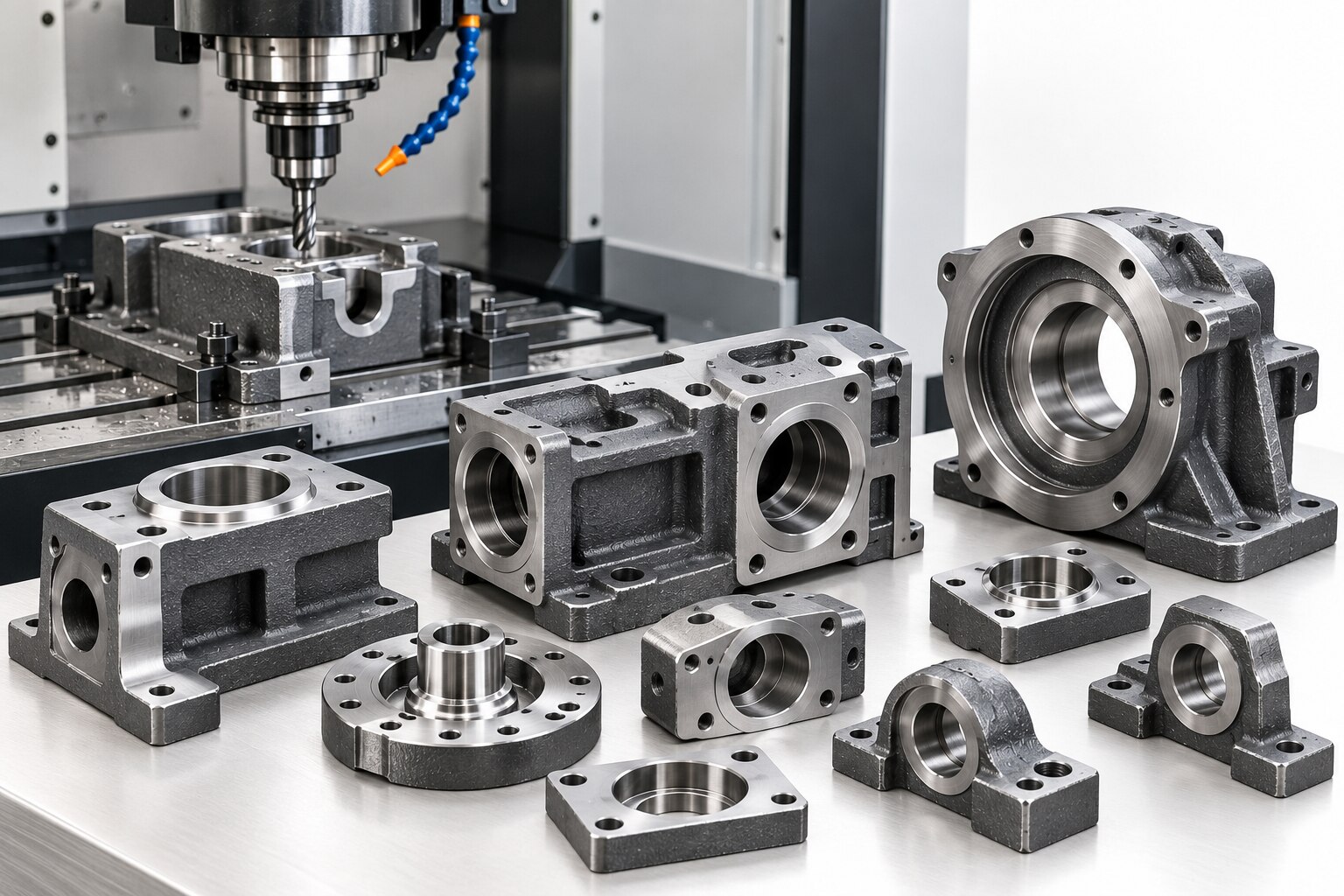
Facing a cast iron casting on a vertical machining centre creates controlled datum surfaces from which later dimensions and hole patterns can be located. Pocketing and slotting remove material from open areas; drilling and boring produce holes and bores; tapping creates threads. Contouring forms profiles, mounting surfaces and curved features.
A raw casting retains mould surfaces, draft and variable dimensions. VMC machined CI parts have defined faces, features and tolerances, but “VMC components” describes a process, not a material grade or quality level.
| Option | What it means | Best suited to |
|---|---|---|
| Raw casting | Mould skin and variable stock remain | Unmachined structural forms |
| Manually milled part | Fewer axes and more repositioning | Simple faces, slots and low-volume work |
| VMC-machined part | Programmed multi-feature milling in one setup or several controlled setups | Pockets, bolt patterns, profiles and mounting faces |
| Turned part | Rotation generates the feature | Shafts, external diameters and concentric bores |
Choose a hybrid route when the part combines feature types: turn cylindrical features, use the VMC for bolt patterns and pockets, then grind bearing seats or sealing faces when the drawing demands finer finish or tighter size control.
For a request involving vmc components cast iron parts in pune, specify:
- Cast iron grade and casting route
- Drawing revision and finished datums
- Tolerances, surface-finish limits and machining allowance
- Batch size and inspection requirements
Do not ask only for “CI components.” State these details so suppliers quote the same part, rather than different castings under one description.
Choosing the Cast Iron Grade and Machining Route
Graphite morphology, matrix structure and hardness determine how a cast iron part cuts. Grey iron’s flake graphite usually breaks chips readily, but releases graphite dust. Ductile iron’s nodular graphite and stronger matrix can impose greater cutting loads.
Compacted graphite iron sits between them and demands closer tool-life control because its tougher structure resists clean chip separation.
| Grade or condition | VMC machining effect | Buyer’s control |
|---|---|---|
| Grey iron | Free-cutting chips; graphite dust; hard skin or chilled areas can chip edges | Control dust and reduce engagement through the first millimetres of sand-cast skin |
| Ductile iron | Higher cutting loads; matrix hardness strongly affects wear | Confirm hardness and use a defined tool-life allowance |
| Compacted graphite iron | Tougher cutting and less predictable tool wear | Request trial cuts before repeat production |
Chilled sections and abrasive inclusions can turn one casting into a tool killer. Two castings with the same nominal grade can produce different tool life and surface finish, so request trial cuts or agree a tool-life allowance for repeat VMC machined CI parts.
IS 210 designations FG 150, FG 200, FG 260, FG 300, FG 350 and FG 400 identify minimum tensile-strength classes in MPa, not hardness or machinability. Write “IS 210 FG 260,” not “CI,” on the RFQ.
Define machining allowance, minimum remaining wall, and acceptable porosity or inclusion limits. Stock removal can expose a blowhole inside a bore or face; state whether the result requires rejection, approved concession, weld repair or metal-filled repair.
For cast iron components in Pune, include the casting process and condition in the enquiry. A cosmetic check of the raw surface cannot prove a machined face is sound.
What the Drawing and Casting Must Tell the Machinist
A supplier can quote and fixture cast iron components in Pune only when the drawing identifies the material standard and grade, casting process and condition, drawing revision, casting allowance, machining allowance, datum scheme, critical linear dimensions, geometric tolerances and minimum wall thickness.
State whether the supplied rail casting parts are as-cast, stress-relieved, shot-blasted or otherwise treated.
| Drawing item | Specify | Why it matters |
|---|---|---|
| Material | IS 210, grade, heat or melt traceability | Prevents incompatible machining and inspection |
| Datums | Functional mounting faces and hole-pattern datums | Controls fixture location |
| Features | Diameters, depths, counterbores, countersinks, thread size and class | Prevents incomplete tool and gauge planning |
| Blind holes | Bottom depth, drill point acceptance and flat-bottom requirement | Avoids interference and weak thread engagement |
| Finish | Ra 3.2 µm on named functional face, measured at stated location with 0.8 mm cutoff | Makes results comparable |
| Edges and surfaces | As-cast zones, deburring, edge breaks, shot blasting, coating and corrosion protection | Defines the delivered condition |
Use ISO 1101 GD&T for relationships between mounting faces and hole patterns, with position tolerances tied to functional datums. Do not use ISO 2768 instead of explicit tolerances for bearing seats, rail interfaces or functional holes.
Before approval, confirm stock on every machined surface, cleaned locating pads, sacrificial cast pads where needed, accessible features, safe clamping points, expected casting distortion and the number of setups. Separate roughing and finishing when stress release could move the part; specify a controlled rest or stress-relief treatment, then require a datum recheck after rough machining.
How to Control Cutting, Fixturing and Inspection on the VMC
A repeatable VMC job controls cutting data, location, measurement and traceability—not just the toolpath. Match carbide inserts to the material: sharp, wear-resistant grades for grey iron, tougher edges for ductile iron, and close tool-life control for compacted graphite iron.
Reduce radial and axial engagement through hard skin, then document the response to flank wear, edge chipping, poor finish and unexpected inclusions.
Dry cutting avoids carrying graphite and abrasive fines through a sump. Coolant is acceptable only with filtration, scheduled sump cleaning, enclosure management and protection of machine ways.
| Dry cutting | Prevents graphite and fines entering the recirculation system | Provide chip evacuation and graphite-dust extraction |
|---|---|---|
| Coolant cutting | Improves heat and chip control | Filter continuously, clean the sump, manage splash and protect ways |
Use dedicated fixtures locating on cleaned, sufficiently large pads or machined sacrificial pads. Add repeatable stops, and clamp near strong sections so thin walls do not distort. Probe work offsets and verify critical features during the cycle.
Use in-process gauges for bores and mounting faces, then complete final checks with a calibrated height gauge or CMM. Require:
- First-article inspection report and tool-life records
- Casting-batch traceability and a defect map when machining exposes porosity
- For rail casting parts, a material test certificate linked to melt or heat number, casting batch and machining batch
- The applicable RDSO or railway drawing requirement, NDT method and mechanical tests
A vmc components supplier in pune should provide this evidence before production approval.
How to Compare Pune Suppliers and Quotes for the Same Part
A VMC components supplier in Pune must prove control on your part, not quote a brochure’s positional-accuracy figure. Request the casting source and process, grade certificate, casting inspection plan, fixture concept, machine capability, probing method, CMM or height-gauge capability, current calibration records, first-article approval process, feature-by-feature inspection report and repeatability evidence from a real batch.
Ask how the supplier controls casting distortion and tool wear, and what happens when machining exposes porosity, blowholes or inclusions. Require written rules for weld or metal-filled repairs, rejection, rework and concession approval. For rail casting parts, require heat or melt, casting-batch and machining-batch traceability plus the railway drawing, purchaser specification or RDSO acceptance conditions.
Compare quotes as separate cost lines:
| Pattern | Pattern manufacture or modification |
|---|---|
| Raw casting | Supplier-supplied or buyer-supplied casting |
| Rough machining | Stock removal and stress-release route |
| Finish machining | Final features, datums and tolerances |
| Fixture | Design, manufacture and ownership |
| Programming | CAM and revision changes |
| Inspection | Gauges, CMM, reports and first article |
| Surface treatment | Cleaning, coating or corrosion protection |
| Packing | Protection from corrosion and graphite contamination |
| Transport | Pickup, delivery and insurance |
| Rejection or rework | Responsibility, approval and cost |
Compare prototype, small-batch and repeat-production lead times, not unit price alone. Evaluate Virdaks Engineering India Private Limited against this same evidence: its relevance depends on documented grade, route, inspection, traceability and railway or industrial acceptance.
Buyer checklist: drawing revision; batch size; supplied raw material; acceptance standard; exact delivery report package. Include the feature report, material certificate, calibration evidence and concession records.
Related products
 | Rail Parts Virdaks Engineering Overview Virdaks Engineering offers high-quality CI (Cast Iron) Casting Parts manufactured to meet the demanding requirements of... View product → |
 | CI Parts Virdaks Engineering India Private Limited supplies high-quality Cast Iron (CI) parts engineered to meet strict UK industrial standards. View product → |
Frequently asked questions
What does a VMC do to a cast iron casting?
A vertical machining centre faces datums, mills pockets and contours, drills and bores holes, and taps threads on a cast iron casting.
How do you choose a cast iron grade and machining route?
Choose the grade from the required strength, wear resistance and application, then set the machining route around casting stock, datums and finished tolerances.
What must the drawing and casting tell the machinist?
The drawing must identify datums, dimensions, tolerances, hole locations, threads and surface requirements; the casting must provide adequate stock and consistent features for location.
How can you compare Pune suppliers quoting the same VMC part?
Compare the included operations, workholding, tooling, inspection documents, casting scope, rejection terms, delivery time and whether the quote covers deburring and finishing.
Related product
 | Rail Parts Virdaks Engineering offers precision-manufactured rail parts for railway applications — engineered to meet rigorous standards of durability,... View product → |
Keywords