A VMC order is incomplete when it names only a part and material. You will be able to define the machining route, drawing authority, blank, tolerances, inspection evidence, quantity, and delivery requirements well enough to compare quotations without leaving critical decisions to assumption.
Key takeaways
- Define the machining route, part quantity, tolerances and delivery requirement before requesting a quote.
- Send a revision-controlled drawing with datums, material grade, finish and inspection points.
- State whether the supplier must provide the blank, heat treatment, coating or only machining.
- Request railway documentation, traceability records and inspection reports when rail applications require them.
What a VMC component order actually covers
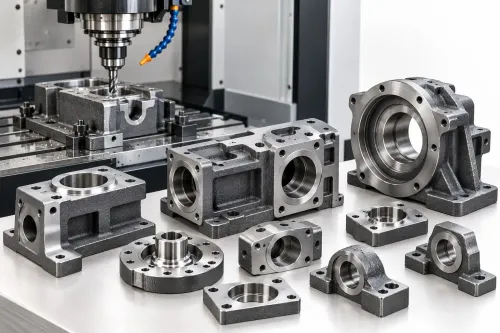
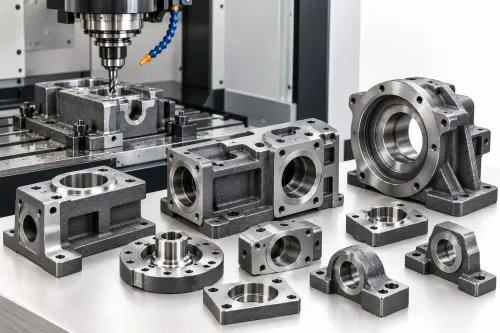
The practical answer to what VMC components in Pune include is a machining route, not a fixed product family. A vertical machining centre suits mainly prismatic parts requiring face milling, drilling, tapping, reaming, boring, counterboring or pocketing.
| Part type | What defines it | Better route when |
|---|---|---|
| VMC-machined component | Milled faces, holes, pockets and datums from a blank | The geometry is accessible with available setups |
| Casting | Shape formed in a mould, then possibly machined | The near-net shape reduces substantial material removal |
| Turned part | Continuous rotational geometry made on a lathe | The part is a shaft, bush or high-volume simple cylinder |
| Fabricated part | Cut, bent or welded from separate pieces | Welded construction is part of the design |
| Grinding-only part | Final geometry depends mainly on abrasive finishing | Tight size, roundness or surface finish follows heat treatment |
Choose another route for continuous rotational forms, high-volume simple turned parts, workpieces beyond machine travel, simultaneous multi-axis geometry, or parts dominated by grinding or EDM. A conventional VMC should not be assumed to produce deep cylindrical bores, turned outside diameters or complete five-axis geometry.
The minimum machined component order scope is a controlled package containing:
- Part drawing and drawing revision
- 3D CAD model and model revision, or model-based-definition authority
- Material grade and raw-material form
- Required machining processes
- Heat treatment and surface treatment
- Inspection level and packing requirements
A CAD file without a controlled 2D drawing or authoritative model-based definition leaves tolerances, datums and acceptance criteria open to dispute. Agree the package before quoting, not after the first component fails inspection.
The buyer-ready VMC components order-details checklist
Put these VMC components order details into the RFQ or purchase order:
- Identify the part number, drawing number, drawing revision and 3D-model revision. State the material grade, supply condition and controlled drawing or model authority; an uncontrolled CAD file leaves acceptance criteria open.
- State prototype or first-off quantity, recurring batch size, forecast or annual quantity, required delivery date and delivery splits.
- Define the machined component order scope: required processes, inspection level, heat or surface treatment, and packaging.
Blank responsibility changes both price and risk:
| Option | Buyer must define | Commercial consequence |
|---|---|---|
| Supplier buys bar or plate | Grade, supply condition and certificate | Yield, minimum lot size and remnants affect price |
| Supplier buys forging or casting | Grade, tooling or pattern ownership, allowance and blank inspection | Supplier responsibility for defects, distortion and tooling changes must be agreed |
| Customer supplies blank | Quantity, incoming inspection, allowance and rejection rules | The supplier machines the supplied condition and does not automatically accept casting or forging defects |
State whether programming, probing and fixture charges are one-time, included in the unit price or amortised across serial batches. Prototype pricing can therefore differ sharply from repeat pricing.
Name packing controls that protect faces and traceability: corrosion-preservation method, separators, individual wrapping, labels, serial numbers and permitted container types. Also specify whether each delivery split needs a separate certificate, lot identification and packing list.
The drawing details that make a VMC quotation usable
A usable quotation starts with a controlled drawing, not a file name and a material label. Include drawing units, drawing and 3D-model revisions, material grade and condition, general tolerances, individual size tolerances, geometric tolerances, datum letters, critical dimensions, radii, chamfers, and surface-finish values such as Ra.
1. Mark functional features separately from the general tolerance block. Give individual requirements for hole position, bearing seats, mounting faces, sealing diameters, datum relationships, and surface finish; a general tolerance cannot define the tighter location, form, or finish an assembly needs.
State the Ra measurement direction, evaluation length when controlled, and whether the limit applies before or after coating.
2. Complete every hole callout with nominal diameter, through or blind condition, depth, thread standard and class, thread depth, drill diameter where relevant, counterbore or countersink diameter and depth, datum reference, and positional tolerance. “Drill and tap as required” leaves programming and acceptance open to dispute.
3. Flag deep pockets, thin walls, small internal radii, long overhangs, interrupted cuts, and holes on several faces. These features can turn a simple VMC components order details review into a fixture and access problem.
4. Ask for the proposed datum scheme, number of setups, workholding method, probing plan, and any fourth-axis requirement. Each re-clamping can add location error, alter the machined component order scope, and increase fixture cost.
5. Confirm whether the supplied CAD model governs missing dimensions. Without controlled 2D drawing authority or model-based definition, tolerances, datums, and acceptance criteria remain ambiguous.
How to specify the blank, material and finishing route
A buyer asking what VMC components in Pune include should expect more than a material nickname. State the exact aluminium alloy, cast-iron grade or stainless-steel grade, supply condition, hardness range, raw-material form and required material certificate. Identify whether the supplier buys bar, plate, forging or casting, or machines a customer-supplied blank.
1. Link the incoming blank to the finished lot with the heat or melt number, supplier batch number, heat-treatment record, and required chemical and mechanical results. Do not accept “material certificate” without naming the document and tests.
2. For a casting, specify casting grade, heat-treatment condition, datum pads or datum features, machining allowance and distortion controls. State acceptance limits or inspection method for porosity, shrinkage, inclusions, and other surface-breaking or internal defects.
3. Define every post-machining operation: heat treatment, anodising, plating, blackening, painting, washing, preservation, marking, serialization, balancing, assembly and packing. Replace “deburr” with an edge-break or chamfer limit, such as 0.2–0.5 mm, where fit, sealing or safe handling depends on it.
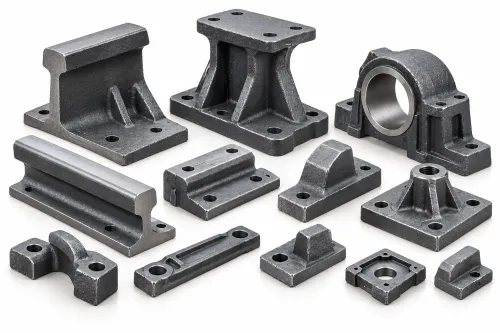
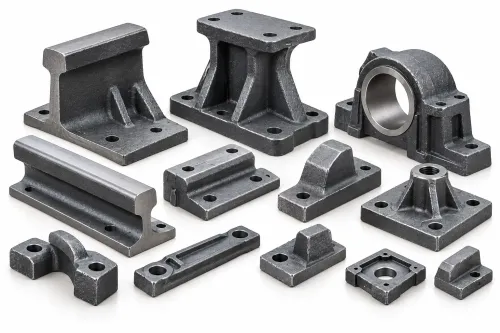
For rail VMC components, add approved-source requirements, special-process records and document retention when the controlled railway drawing calls for them. Keep the material evidence and finishing route tied to the correct drawing revision, model revision and finished lot.
Inspection, railway requirements and the supplier decision
Delivery evidence must separate in-process control from final acceptance. In-process records show how datums, setups, probing and machining were controlled; final records show whether the completed part meets the drawing. A certificate of conformity alone does not prove that every critical characteristic was measured.
Request this package before approving the order:
- First-off or first-article report with ballooned drawing results for every critical characteristic
- Calibrated equipment records, including calibration status for CMMs, micrometers, bore gauges and height gauges
- Thread plug, ring-gauge and functional-gauge results, plus Ra readings for specified surfaces
- Material certificate showing grade, heat or melt number, supplier batch and heat-treatment results
- Agreed serial-production sampling plan, including characteristics, frequency, lot definition and reaction to failure
For rail VMC components, the customer’s controlled drawing and railway specification override a generic machining standard. Confirm heat-number traceability, approved material and process sources, special-process records, defined NDT, nominated-agency inspection, serialization and document retention. ISO 9001 supports a quality system; it does not replace railway approval or product qualification.
Compare a VMC parts supplier in Pune on evidence, not only unit price:
| Supplier evidence | What it proves | Risk if absent |
|---|---|---|
| First-article and serial reports | Controlled acceptance | Unmeasured critical features |
| Setup and fixture plan | Datum retention | Re-clamping error |
| Material and process records | Traceability | Unverifiable rail compliance |
Virdaks Engineering India Private Limited should be assessed against this complete material, machining, inspection and documentation package, not a VMC capability claim alone. That is what VMC components in Pune include when acceptance matters.
Frequently asked questions
What do VMC components in Pune include before ordering?
A usable order scope identifies the part, quantity, machining operations, drawing revision, material, blank source, finishing route, inspection requirements and delivery terms.
Which drawing details make a VMC quotation usable?
Provide a revision-controlled drawing with dimensions, tolerances, datums, surface-finish values, hole specifications, threads, material grade and any special inspection points.
What should you specify about the blank, material and finishing route?
State whether the supplier provides a casting, forging, bar or pre-cut blank; name the material grade; and list heat treatment, coating, deburring and surface-finish requirements.
What should you ask a VMC parts supplier in Pune for railway components?
Ask for material traceability, inspection records, dimensional reports and any railway-specific documentation, approvals or process controls required for your application.
Keywords